SEA Data Processes Toolkit


Does your state have well-documented data processes in place to ensure that IDEA data are timely, accurate, valid, and reliable? If not, contact your IDC State Liaison for help! Using the SEA Data Processes Toolkit, our TA providers can work with state special education staff and others in your state to document your current 616 and 618 data processes. IDC can also assist with improving those processes to ensure consistent practices to collect, analyze and submit high quality data year after year!
Did You Know?
Writing down your processes and related information can make a huge difference in creating a well-managed system for data collection both now and in the future. The IDC team is always here to help you think through every step to meet your SEA’s unique needs.
Reach out to your IDC State Liaison today!
SEA Data Processes Toolkit: Overview
Share this overview with your state team as you begin building your documentation processes. It’s a great tool to discuss and get everyone on the same page across the agency.
Download the OverviewToolkit Components
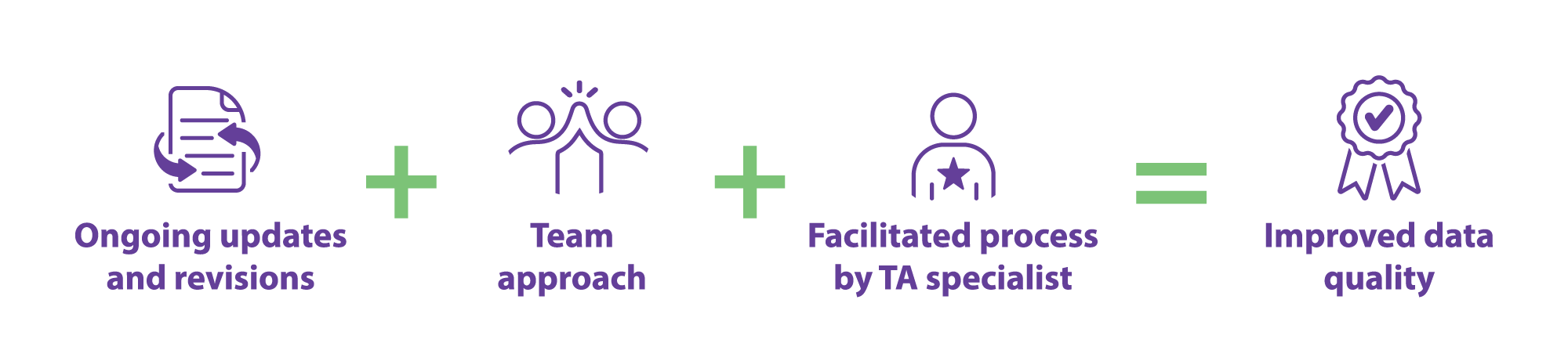
Equation for Success
We encourage LEAs to use the LEA Data Processes Toolkit in collaboration with their state education agency (SEA) and LEA contacts as well as IDC technical assistance (TA) specialists, who can facilitate and document the data processes in real-time during the discussion. They will walk through in a way that is supportive and responsive to each LEA’s unique needs.
This process has empowered us to help other departments better understand federal requirements. We will use the processes for DMS, to onboard new staff, and to improve our monitoring and compliance documents that LEAs have access to in order to help them become more literate about the data.
Now as we are documenting our processes, it is strengthening us by helping us know more for succession planning because we are documenting where data resides and who is responsible. By documenting everything, it will allow someone to come in the future and know where to go. It will go a long way towards improving our processes in the state.
618 Data Collection Calendar
This tool helps states plan for and submit the 618 data collections on time and accurately. Each collection report includes a due date with corresponding timelines for tasks and activities.

Quick References for IDEA Part B, 2025
This quick reference guide brings essential information about IDEA data requirements together in one place. These references may be useful for new and experienced state staff who work with IDEA data and who need an easy way to reference key information.
This protocol serves as an overview of state infrastructure. It covers background information on the state, including descriptions of the data systems, key staff, and general policies and procedures that apply to IDEA data.
- State Landscape Protocol Updated!
These protocols cover information about each of the 18 SPP/APR indicators, as defined by Section 616 of IDEA. States submit the data to OSEP via the APR Tool for the SPP/APR.
- Indicator 1. Graduation Updated!
- Indicator 2. Dropout Updated!
- Indicator 3. Assessment Updated!
- Indicator 4A. Suspension and Expulsion: Percent of LEAs With Significant Discrepancy Updated!
- Indicator 4B. Suspension and Expulsion: Percent of LEAs With Significant Discrepancy by Race/Ethnicity Updated!
- Indicator 5. Education Environments (School Age) Updated!
- Indicator 6. Preschool Environments Updated!
- Indicator 7. Preschool Outcomes Updated!
- Indicator 8. Parent Involvement pdated!
- Indicator 9. Disproportionate Representation Updated!
- Indicator 10. Disproportionate Representation in Specific Disability Categories Updated!
- Indicator 11. Child Find Updated!
- Indicator 12. Early Childhood Transition Updated!
- Indicator 13. Secondary Transition Updated!
- Indicator 14. Post-School Outcomes Updated!
- Indicator 15. Resolution Sessions Updated!
- Indicator 16. Mediation Updated!
- Indicator 17. State Systemic Improvement Plan Updated!
- Indicator 18. General Supervision Updated!
These protocols cover information about the seven data collections defined in Section 618 of IDEA. States submit these data to OSEP via EDPass files in the EDPass and the EMAPS systems.
- 618 Assessment Updated!
- 618 Child Count Educational Environments Updated!
- 618 Discipline Updated!
- 618 Dispute Resolution Updated!
- Exiting Updated!
- 618 MOE Reduction Updated!
- 618 Personnel Updated!
This protocol covers processes for using data to establish an LEA’s annual determination. It includes information about which data a state will use for that determination and how the state should calculate and share the determination.
- LEA Determinations Updated!
States can use the workbooks within this protocol for documenting, recording, and communicating existing business rules or data quality validation checks. This is especially helpful during the collection and validation of IDEA Part B data.